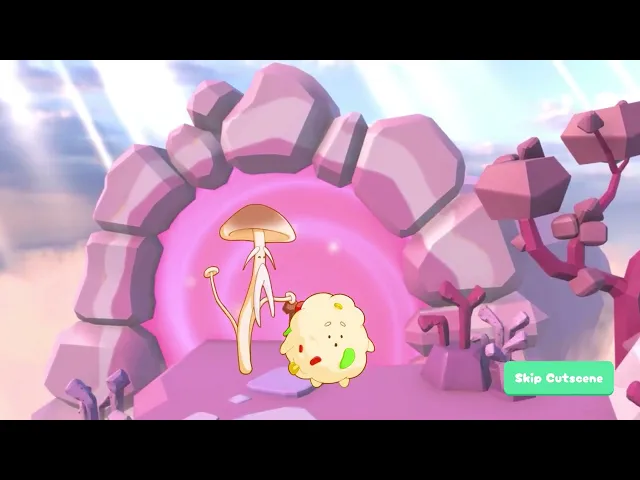
I AM BOLUS - AN EDUCATIONAL DIGESTIVE SYSTEM GAME

MScBMC @ UofT

Click on the image above to be redirected to another window to play the game!

If you are unable to access the game itself, here is a video that show the full gameplay of the demo.

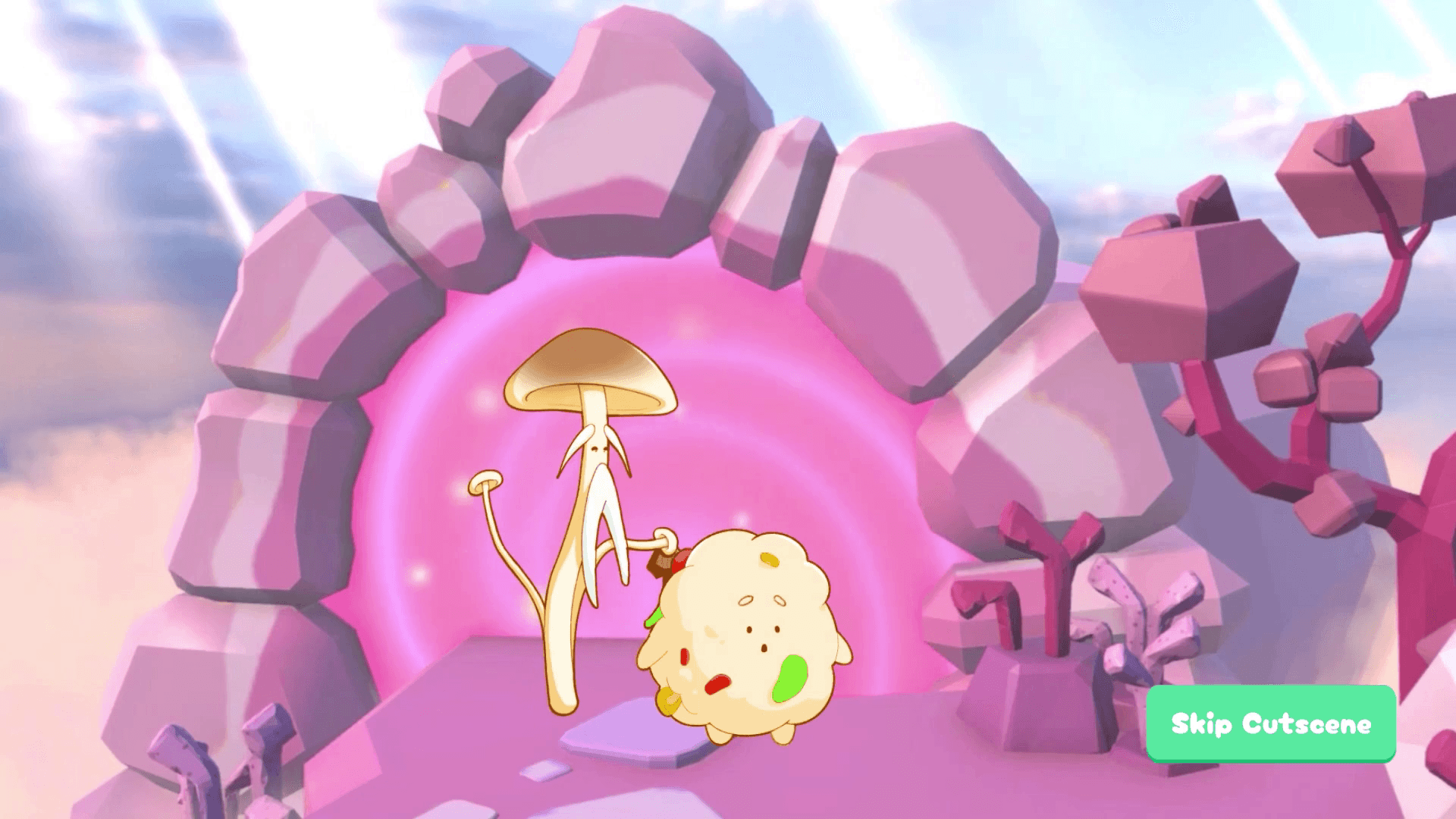
“I Am Bolus” is a concept of an educational interactive game that was created in Shehryar Saharan’s Advanced Media Design course. This project was a collaborative effort between myself, Qingyue Guo, Eve Higgins, Athena Li, Vicky Lin, Beverly Ng, and Raymond Zhang. In the game, you play as a bolus (a ball of chewed up food) traversing the digestive system on its journey towards "enlightenment." Your guide during this quest is an undigested Elder Enoki mushroom, who uses his experience to guide you through the different trials during the process of digestion. Learning objectives in the game are tailored towards the course curricula of high school and 1st year undergraduate students in Ontario and Canada.

TARGET AUDIENCE

High School and 1st Year Undergraduate Students

TOOLS USED

Unity, Maya, Blender, Procreate, Adobe After Effects, Adobe Photoshop, Adobe Illustrator, Figma, Adobe Audition, Audacity

MY ROLES

Script writing, Storyboarding, Sound/Music, 3D asset creation, Unity Development

RESEARCH

The first part of our research focused on examining course curricula and textbooks from various high schools and universities across Ontario and Canada.


The research we did to flush out this idea was two-pronged:


  1. determine core learning objectives that will need to be addressed in the game

  2. determine strategies for using the video games as an educational tool

RESEARCH

The subsequent research we did to flush out this idea was two-pronged:


  1. determine core learning objectives that will need to be addressed in the game

  2. determine strategies for using the video games as an educational tool


The first part of our research focused on examining course curricula and textbooks from various high schools and universities across Ontario and Canada. This helped us decide what particular topics within the broad concept of digestion would need to be covered within our game. We decided to keep our research constrained to courses targeted towards high school and 1st year university students, so as to keep our game streamlined towards the same audience.

We found particular concepts repeated among all the different curricula we examined. Because of this commonality, we felt that these topics should be focused on in our game. This would allow the game to be good tool to teach these widely taught concepts among different school districts.

The second part of our research focused on understanding game-making strategy, especially how to use video games effectively as an educational tool. Our key findings were:


  1. the GAME OBJECTIVES (the goals that the player has to achieve to beat the game) need to be aligned with the player/student's LEARNING OBJECTIVES (the educational topic that is being taught by the game). When these two are intrinsically integrated, this ensures that learning occurs while playing the game - i.e. learning how to play the game should in essence teach the player about the specific education topic (van der Linden, A. et al., 2019)


  2. a game has various constructs that all influence the player's learning experience, as per Ishak S. et al. (2023). In particular

    • INTRINSIC MOTIVATION is the player's desire to continue through the game. If a player is not interested in playing the game, they will not experience the full educational experience

    • GAME FEATURES are the graphical elements in the game that visually stimulate the learner to increase interest and engagement

    • ENGAGING GAME EXPERIENCE allows the player to have a positive experience and contributes to their enjoyment, thus increasing their motivation to complete the game.


  3. providing the player with choices and allowing them to experiment with their decisions in the game incorporates an integrated form of learning in which the player learns through the consequences of their actions. Choices that result in a consequence and prevents the player from progressing in the game essentially confronts the player's pre-existing ideas, which then necessitates an alteration in the player's own theories and forces them to adopt a new one in order to progress through the game. In other words, moving past failure ensures that the player is learning (van der Linden et al., 2024).

MEDIA AUDIT

With the knowledge gained from our preliminary research, we decided to conduct a media audit of different educational games. We decided to open this audit to any education game rather than limiting ourselves to games that are specifically focused on the digestive system. This is because our objective with this audit was to elucidate effective educational strategies within the role of video games, and this isn't necessarily limited to the topic of the digestive system. Some of the games we audited were Kerbal Space Program, White true learn(), In Digestion, and Kingsoft Typing. We loosely examined the games based on evaluation criteria outline in the Serious Games Evaluation Scale (Fokides, E. et al., 2019) in order to get a better sense of how different games apply different strategies to increase engagement and then determine if these strategies were effective in their educational goals. Here is an example of the evaluation of Kerbal Space Program:


MEDIA AUDIT

With the knowledge gained from our preliminary research, we decided to conduct a media audit of different educational games. We decided to open this audit to any education game rather than limiting ourselves to games that are specifically focused on the digestive system. This is because our objective with this audit was to elucidate effective educational strategies within the role of video games, and this isn't necessarily limited to the topic of the digestive system. Some of the games we audited were Kerbal Space Program, White true learn(), In Digestion, and Kingsoft Typing. We loosely examined the games based on evaluation criteria outline in the Serious Games Evaluation Scale (Fokides, E. et al., 2019) in order to get a better sense of how different games apply different strategies to increase engagement and then determine if these strategies were effective in their educational goals. Here is an example of the evaluation of Kerbal Space Program:

USER RESEARCH AND PERSONAS

Based on our research, we hypothesized that the user's drive to continue the game is driven by two main factors:


  1. innate motivation to engage with the learning content

  2. familiarity with digital gaming


The spectrum created by these two variables generated four user personas that we would use to represent subsets of our theoretical target audience.

Figure 1:

A graph formed by axes of a user's innate motivation to learn and their familiarity with gaming. This created four quadrants, which we personified as different user personas.

Figure 1:

A graph formed by axes of a user's innate motivation to learn and their familiarity with gaming. This created four quadrants, which we personified as different user personas.

We decided to focus our user persona examination on two extremes: Elio the Explorer and Pauli the Procrastinator.


Elio is curious about learning and inexperienced with video games. Maximizing the game's usability for someone like Elio would require intuitive game controls and explicit guidance on how to progress in the game.


Pauli is an experienced gamer, but has a low motivation to learn. For Pauli, the game would need to have the learning integrated directly into the gameplay to meet the learning objectives.

Figure 2:

The user personas we examined in our user research: Elio the Explorer (left) and Pauli the Procrastinator (right)

Figure 2:

The user personas we examined in our user research: Elio the Explorer (left) and Pauli the Procrastinator (right)

NARRATIVE


We wanted the game to be engaging, and felt that using character-driven narrative would achieve this goal. In our game, the player plays as a monk-bolus (a chewed up ball of food) who is on a pilgrimage through the digestive system in order to reach "enlightenment". Throughout the game, the player will be accompanied by an undigested enoki mushroom, who we refer to endearingly as Elder Enoki. He uses his knowledge of the digestive system to guide you towards nirvana.

PRE-PRODUCTION

  1. Character Design

One of the first tasks we tackled in pre-production was the design of the characters. We created initial concept art, and as you can tell from the image below, the Elder Enoki was originally meant to be an undigested corn kernel. We opted to switch an Enoki mushroom to provide a more unique and distinctive character silhouette for this character.

PRE-PRODUCTION


Finally! We can begin the game design. But wait! We first needed to figure out what each person in the group would be doing. This inevitably allowed us to delegate different roles to different people and reduced the workload for each team member.

Figure 3:

Initial Character Design

Figure 3:

Initial Character Design

Upon further iterations, we arrived at much more refined characters that matched the style that we wanted for both the bolus and the enoki characters.

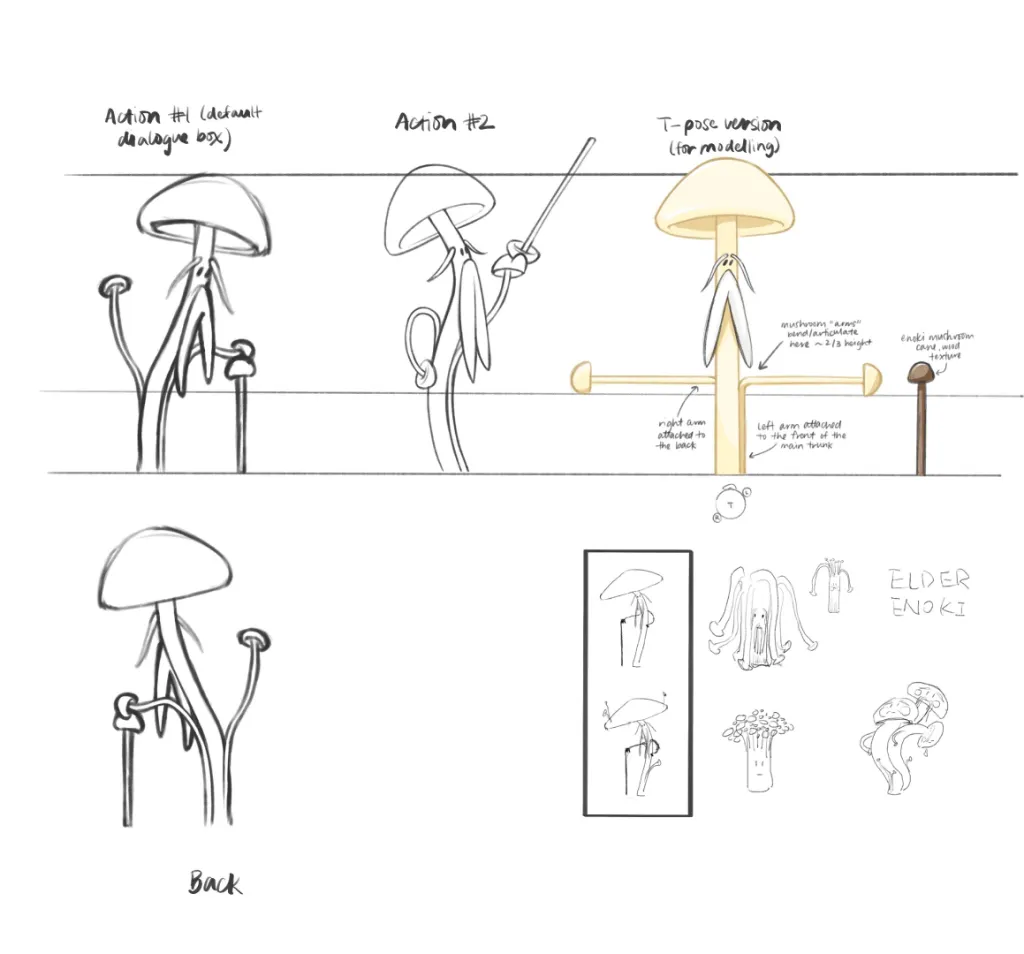
Figure 4:

Refined Character Designs

Figure 4:

Refined Character Designs

ii. Level Structure

The next task involved designing the levels. We focused on the stomach to create a minimum viable product (MVP) that would incorporate multiple learning objectives and game mechanics within our representative game demo.

STORYBOARDING

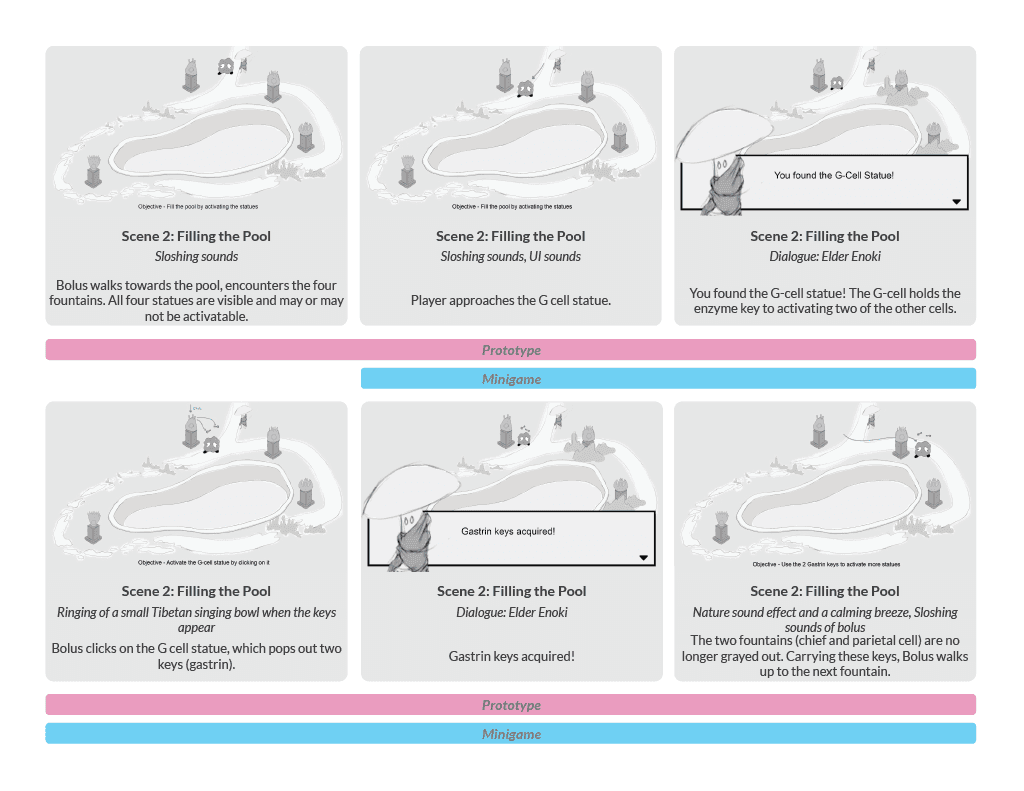
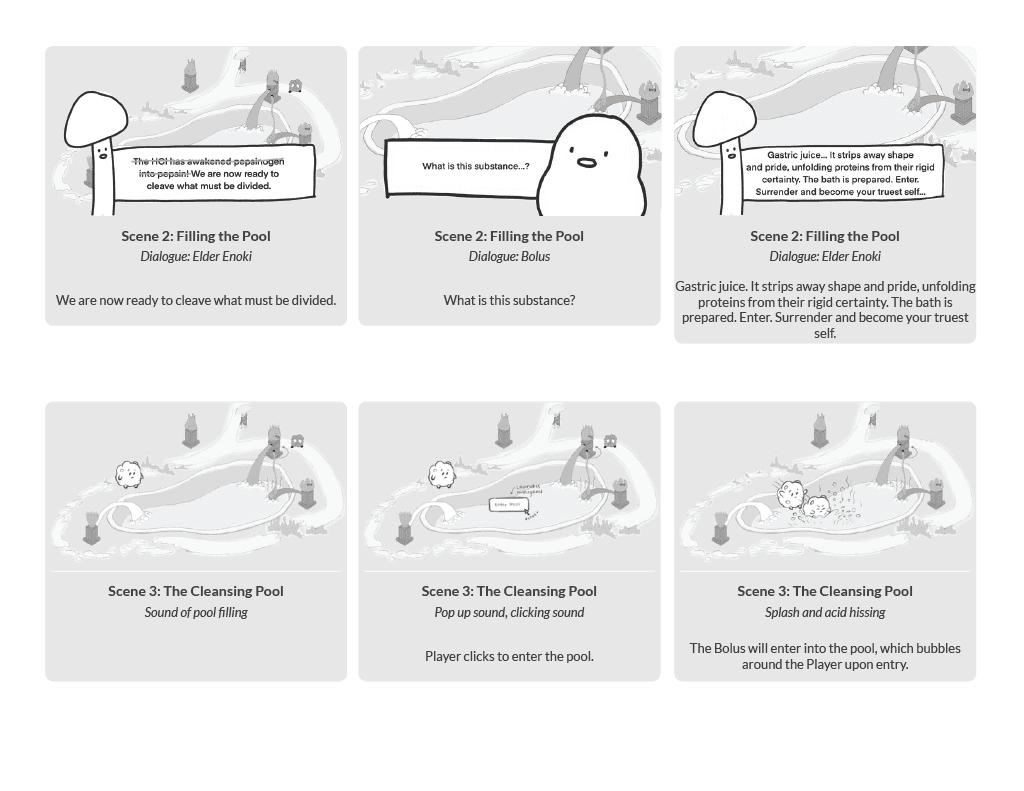
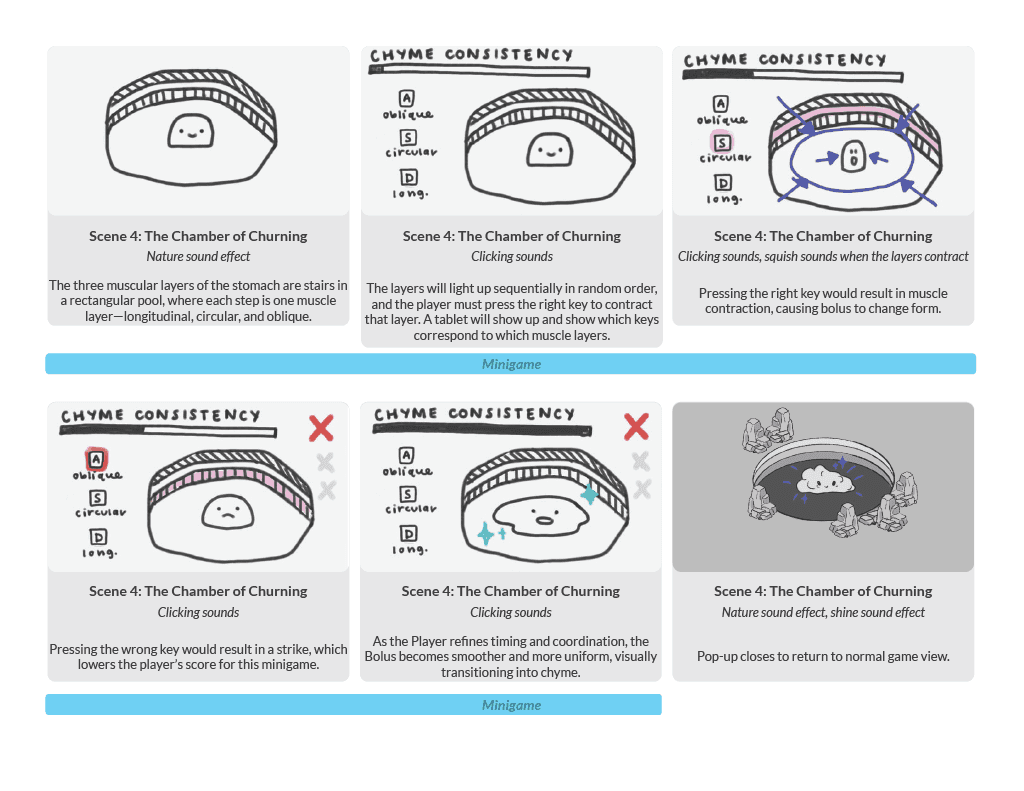
Within the pre-production phase, a significant amount of time was spent on storyboarding the sequence of events that would occur during gameplay. While the game itself is nonlinear and the player can choose to play the game however they want, a particular sequence of events must completed in sequence in order to progress to the next part of the level.


We made the decision to create a storyboard for the entire stomach level, including all three minigames, not just the first one. This is because understanding how the scene will progress will determine how the it needs to look in past. In this way, we can create a full storyboard of the stomach and know that any decision we make won't deviate from this proposed plan.

Within the stomach level, we aimed to cover three learning objectives using three different minigames:


  1. Initiating gastric juice secretion

  2. Chemical breakdown of the bolus

  3. Physical churning of the bolus/chyme


For our MVP, we focused on addressing the first learning objective by breaking down the associated minigame into four tasks:


  1. Collect gastrin from the G-cell

  2. Activate parietal and chief cells that will secrete hydrochloric acid and pepsinogen, respectively

  3. Activate goblet cells that will secrete mucous that will protect the stomach

  4. Check the bolus' level of digestion, to see if they can pass onto the next level


The image below illustrates a breakdown of the levels, minigames, and tasks specific to the MVP.

Figure 5:

Breakdown of the gameplay for the minimum viable product (MVP)

Figure 5:

Breakdown of the gameplay for the minimum viable product (MVP)

iii. Storyboarding

Even though our MVP only focuses on one learning objective, we decided to create a full storyboard for the entire stomach level, including all three minigames. This would create an overall plan that would guide future development of the game.

STORYBOARDING

Within the pre-production phase, a significant amount of time was spent on storyboarding the sequence of events that would occur during gameplay. While the game itself is nonlinear and the player can choose to play the game however they want, a particular sequence of events must completed in sequence in order to progress to the next part of the level.


We made the decision to create a storyboard for the entire stomach level, including all three minigames, not just the first one. This is because understanding how the scene will progress will determine how the it needs to look in past. In this way, we can create a full storyboard of the stomach and know that any decision we make won't deviate from this proposed plan.

Figure 6:

Storyboards for the game narrative

Figure 6:

Storyboards for the game narrative

PRODUCTION

The next phase of development is to actually begin building the assets in 3D. We used Maya and Blender to model out the 3D assets to be used in the game. We then used Blender's texture painting features to unwrap and colour the assets. Then everything was imported into Unity to assemble the game.

PRODUCTION

The next phase of development is to actually begin building the assets in 3D. We used Maya and Blender to model out the 3D assets to be used in the game. We then used Blender's texture painting features to unwrap and colour the assets. Then everything was imported into Unity to assemble the game.

Figure 7:

Texture painting the stomach level in Blender

Figure 7:

Texture painting the stomach level in Blender

Figure 8:

Assembling assets in Unity

Figure 8:

Assembling assets in Unity

Certain assets were built directly inside of Unity. In particular these were things that relied on Unity's shader engine to create VFX and particle systems. Some examples of these assets include the fountains, the fog around the level, the God rays, the dangerous bubbles, and the judgment tube.

Figure 9:

God ray assets created using Unity's Particle System.

Figure 9:

God ray assets created using Unity's Particle System.

Let's go into a bit more detail about how we used Unity to create one of these assets, in particular the fountains. Firstly, the fountains were actually composed of 3 different parts: the fountain cone, the base ripples, and the mist ring around the base of the cone. These 3D assets were created in Blender and imported into Unity.

Figure 10:

Base meshes for the fountains. From the left, we have the fountain cone, the base ripples, and the mist ring.

Figure 10:

Base meshes for the fountains. From the left, we have the fountain cone, the base ripples, and the mist ring.

We then used Unity's shader graph to create the animated materials that would sell the effect of water moving through the fountain. In the case of the fountain cone, the material had to be layered on top of itself, to give the effect of waves moving on top of the water underneath it.

Figure 11:

The different materials used for the fountains. From the left, we have the the fountain cone material, the mist ring material, and the ripples material.

Figure 11:

The different materials used for the fountains. From the left, we have the the fountain cone material, the mist ring material, and the ripples material.

There was also a 2D component in the production phase. This focused on creating assets for the UI menus and HUDs, the pathology collection badges, and even creating 2D character assets that we would use to create a 2D cutscene at the beginning of the game.
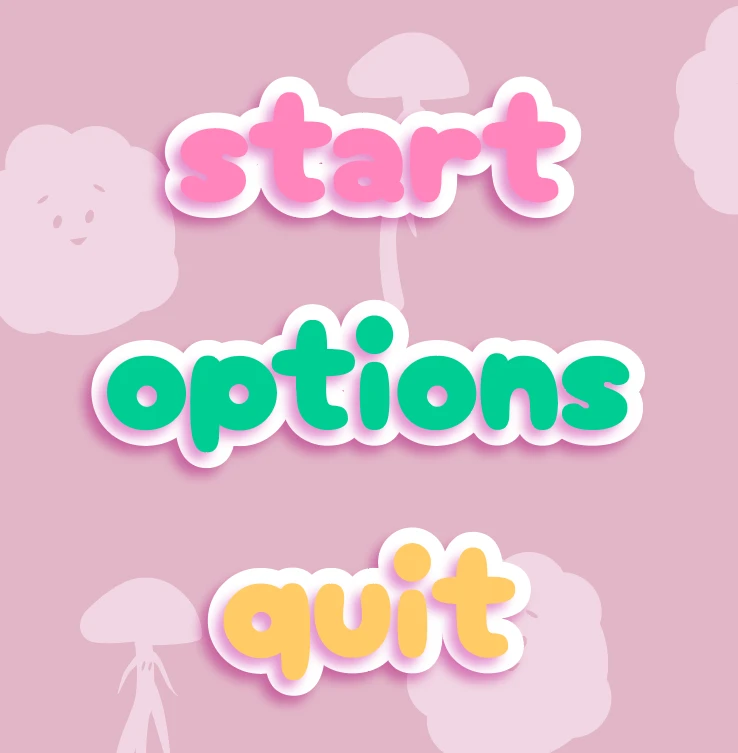
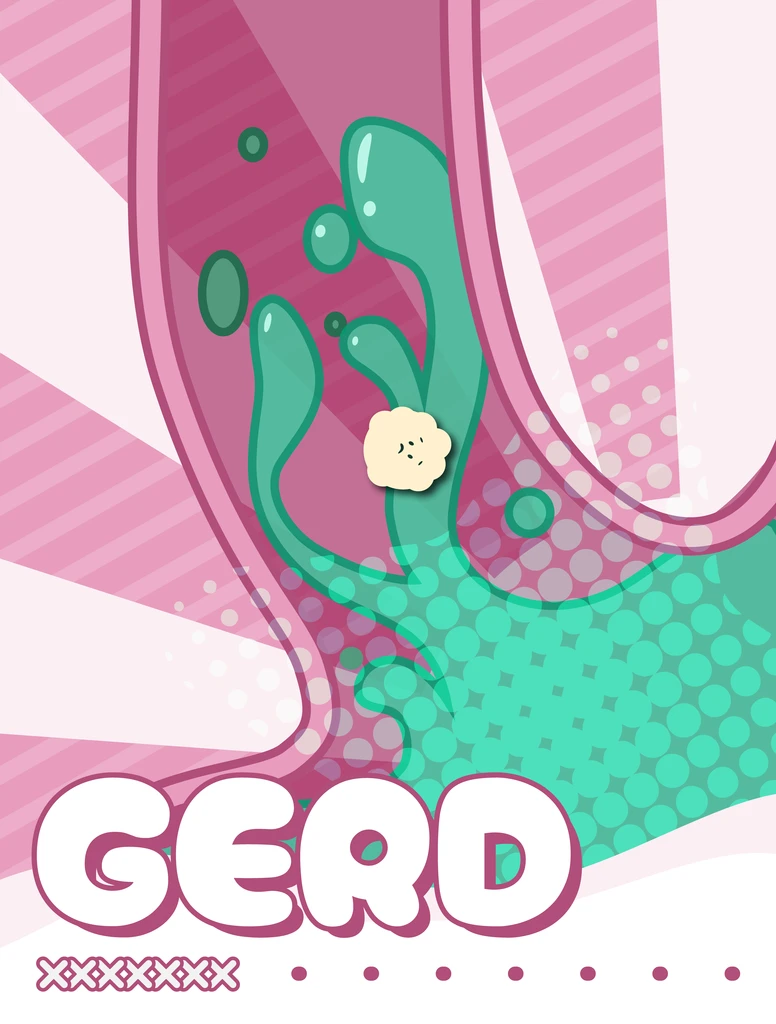
Figure 12:

Examples of the different 2D assets that were created. Starting from the left, we have menu items, pathology collectible badges, and assets for the cutscene.

Figure 12:

Examples of the different 2D assets that were created. Starting from the left, we have menu items, pathology collectible badges, and assets for the cutscene.

SOURCES

  • Fokides E, Atsikpasi P, Kaimara P, Deliyannis I. Let players evaluate serious games. Design and validation of the Serious Games Evaluation Scale. ICGA Journal: The Journal of the Computer Games Community. 2019;41(3):116-137. doi:10.3233/ICG-190111

  • Ishak, S. A., Hasran, U. A., & Din, R. (2023). Media Education through Digital Games: A Review on Design and Factors Influencing Learning Performance. Education Sciences, 13(2). https://doi.org/10.3390/educsci13020102

  • van der Linden, A., van Joolingen, W. R., & Meulenbroeks, R. F. G. (2019). Designing an Intrinsically Integrated Educational Game on Newtonian Mechanics. In M. Gentile, M. Allegra, & H. Söbke (Eds.), Games and Learning Alliance (pp. 123–133). Springer International Publishing. https://doi.org/10.1007/978-3-030-11548-7_12

  • Van Der Linden, A., Meulenbroeks, R. F. G., & Van Joolingen, W. R. (2024). Learning Newtonian mechanics with an intrinsically integrated educational game. Journal of Computer Assisted Learning, 40(4), 1500–1510. https://doi.org/10.1111/jcal.12966

© 2025 Shanghar Roy Kulananthan. All rights reserved.

© 2025 Shanghar Roy Kulananthan. All rights reserved.

Create a free website with Framer, the website builder loved by startups, designers and agencies.